

Keywords
War
Transitional and intermediate spaces
Processes of mediation and symbolization
How to Cite
Abstract
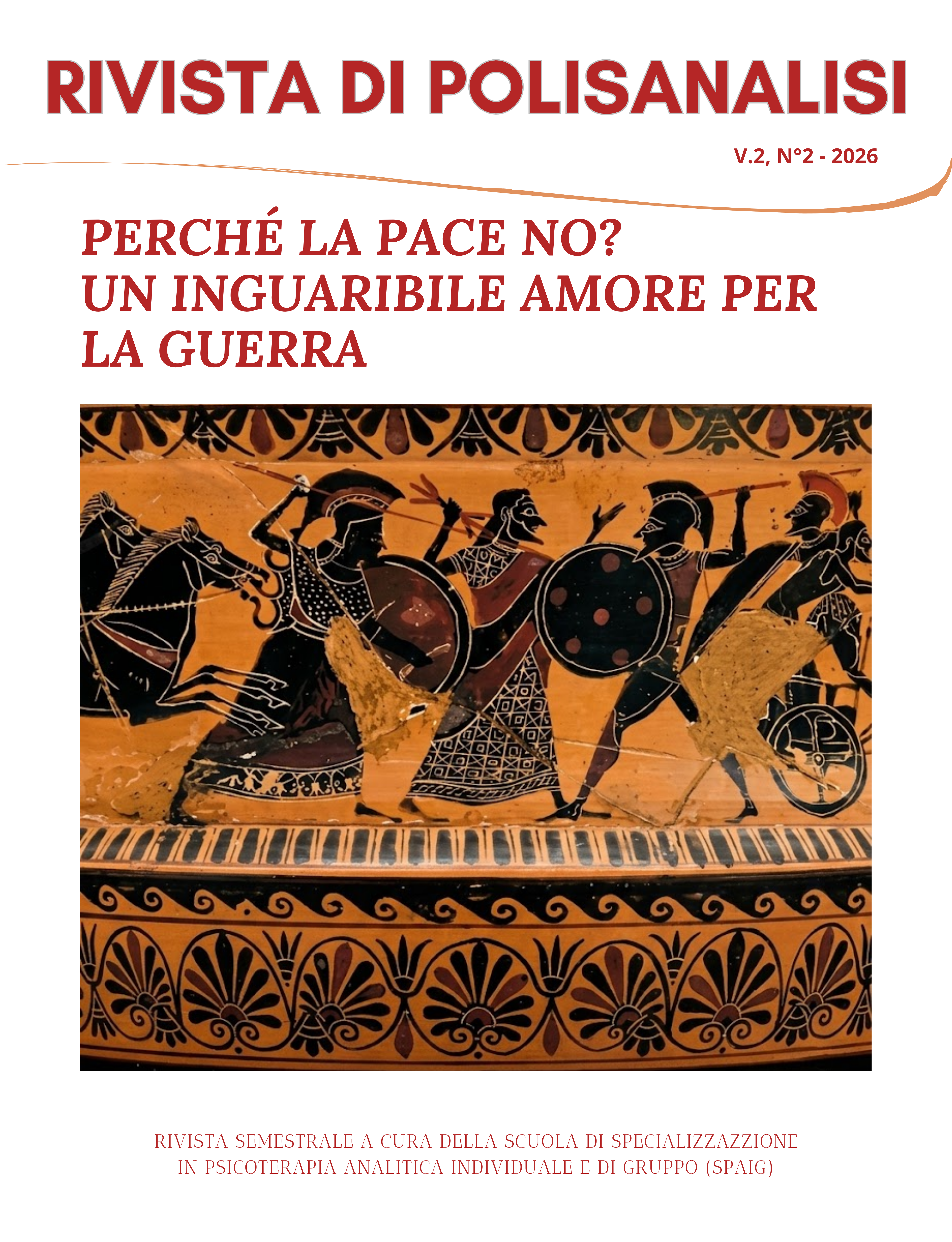
This contribution offers a theoretical reflection on the distinction between war and conflict and on the role of intermediate processes in the construction of civil coexistence. Starting from a critique of the semantic dichotomy peace/war and from the introduction of conflict as a third term (Pagliarani, 1993), the essay develops three intertwined theoretical trajectories: the recognition of the generative value of conflictuality, the theory of liminal and transitional spaces, and the psychodynamic analysis of processes of mediation. Moving across psychoanalytic, psychological and anthropological-social registers, it is argued that the capacity to inhabit conflict — rather than to convert it into war — depends on the quality of the intermediate structures, intrapsychic, intersubjective and cultural, that a society is able to build, guarantee and transmit. War is read as a form of unelaborated collective liminality: it reproduces the morphological features of liminal ritual — suspension of ordinary time, dissolution of customary borders, communitas — while lacking the symbolic frame capable of containing and transforming the chaotic experience it generates. What follows is a psychosocial architecture grounded in hyper-simplification, in the collapse of the modality of the possible and in the attack on linking. The concluding section discusses tertiary processes (Green), negative capability (Bion) and intermediary formations (Kaës) as the foundations of a psychology of generative conflict, and proposes the cultivation of intermediate spaces as an essential form of the work of civilisation.